How to Make an Offer and Submit an LOI on a Business

TL;DR: A letter of intent is the document that converts you from a curious buyer into the only buyer at the table. It is mostly non-binding on price and terms, and binding on the parts that matter operationally: exclusivity, confidentiality, and who pays for what. You submit it earlier than instinct tells you to, because sellers do not open the books until someone has put a number on paper. Price it off your own recast earnings rather than the asking price, give the seller a choice of structures rather than a single take-it-or-leave-it number, ask for 60 to 90 days of exclusivity, and write the deal so the debt service, your salary, and a cushion all fit inside the cash flow. The offer is not the end of your analysis. It is the price of admission to the real analysis.
When should you submit an LOI?
Earlier than most first-time buyers want to.
The instinct is to keep asking questions until you feel certain, then make an offer. That order does not work in small business M&A, because the information you need to feel certain is precisely the information no seller hands out to a tire-kicker. Bank statements, payroll detail, customer-level revenue, the tax returns behind the recast: those arrive after the LOI, not before.
So the practical sequence looks like this:
- Review the listing or CIM and the top-line financials.
- Have one or two real conversations with the seller.
- Build your own recast of earnings and a preliminary valuation.
- Confirm the deal can carry debt at a price in your range.
- Submit the LOI.
- Do the deep work under exclusivity.
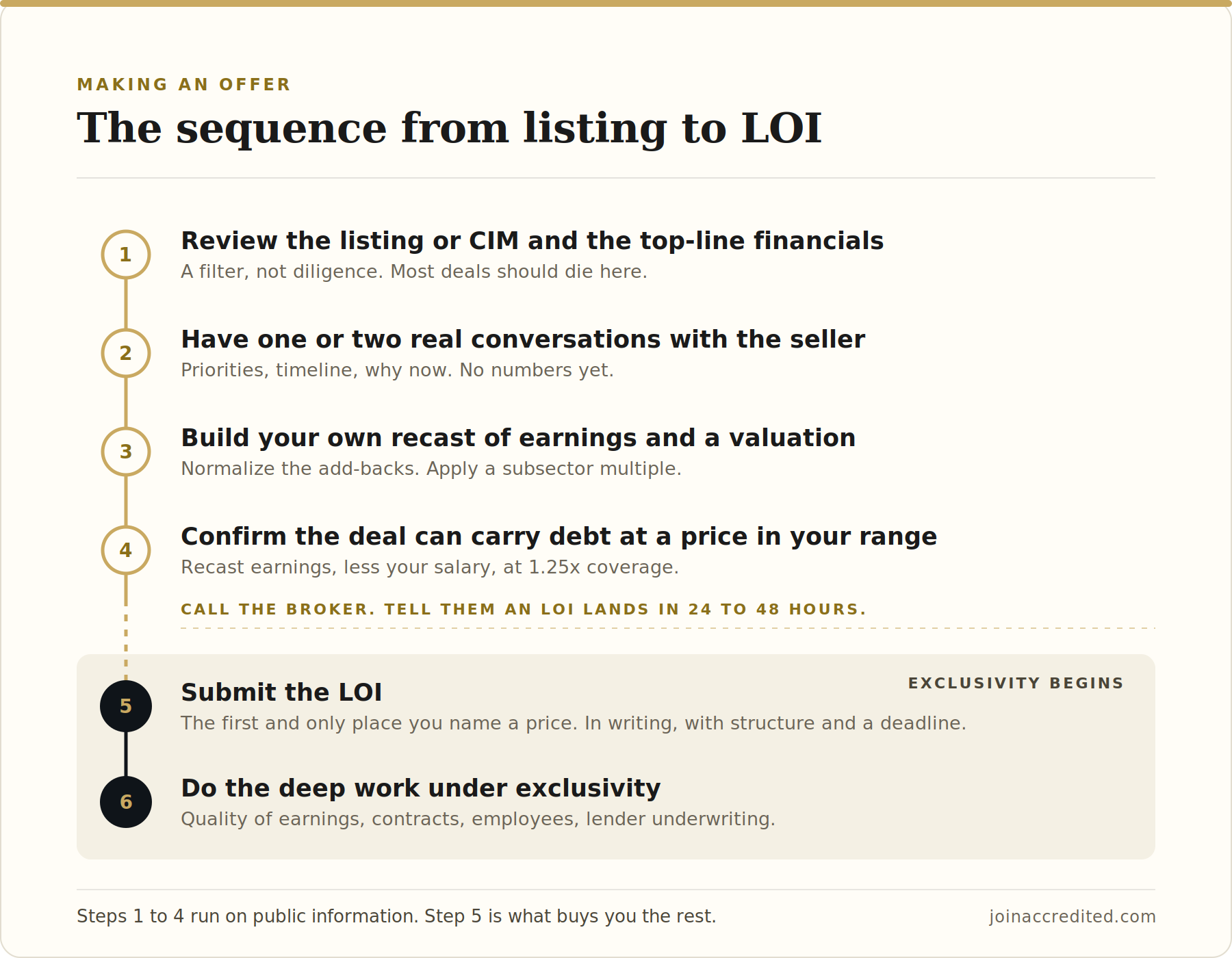
You are not committing to buy at that price. You are committing to spend real time and real money finding out whether that price holds.
The signal to move is when you can answer three questions without guessing: what does this business actually earn, what would I pay for that stream, and can that stream service the debt I would need. If any of those are still blank, you are not ready. If all three are filled in, waiting mostly just gives another buyer the exclusivity window.
What is a letter of intent?
A letter of intent, or LOI, is a two to five page document that sets out the price, structure, and conditions you propose for buying a business, along with the process both sides will follow to get to a purchase agreement.
It is not a contract to buy. Almost every LOI states plainly that the deal terms are non-binding until a definitive purchase agreement is signed. But a handful of provisions inside it usually are binding, and those are the ones with teeth:
- Exclusivity, or the no-shop clause. The seller agrees to stop marketing the business and stop talking to other buyers for a defined window.
- Confidentiality. Usually reaffirming or extending the NDA you signed earlier.
- Expenses. Each side pays its own advisors unless stated otherwise.
- Access. The seller agrees to give you the records and people you need for diligence.
That combination is the whole point. You are trading a credible number for exclusive access. The seller stops shopping, and you get to look at what is actually there.
What makes a strong offer?
Six principles sit underneath every offer that gets signed. They are worth holding in mind before you start filling in numbers.
The offer buys you information. You cannot diligence your way to certainty from the outside. Getting under LOI is what unlocks the real financials and the real access. Buyers who treat the offer as the finish line of analysis have the sequence backwards.
You are buying the future; the seller is selling the past. The seller's price reflects what they built. Your price has to reflect what the business will produce for you, under your ownership, with your debt on it. Those are different numbers and they are supposed to be.
Terms carry as much weight as price. A higher headline price with meaningful seller financing can be worth less risk to you than a lower all-cash price. A seller willing to hold paper is telling you something about their confidence in what happens after they leave, which is information you cannot get any other way.
Credibility beats the top bid. Owner-operated businesses do not always go to the highest number. They go to the buyer the seller believes will actually close and will not gut the place. A buyer who reads as an operator taking over a platform to run and grow, rather than a financial buyer passing through, is the story most sellers want to hear.
Underwrite to cash flow after debt service and your salary. If the deal only works when you pay yourself nothing, you have not bought a business. You have bought a job with a loan attached.
Have a walk-away number before you have a negotiation. Your valuation, done in advance and written down, is the thing that keeps a competitive process from talking you into an extra half-turn of multiple.
How do you set your number before you make an offer?
Three steps, in order.
Recast the earnings yourself. Take the seller's SDE or EBITDA and rebuild it. Add back genuine owner discretionary items, remove add-backs that are really operating costs, and normalize anything one-time. Then subtract the cost of replacing the owner if you will not be doing the job yourself full time. Our guide to the five valuation methods every buyer should know walks through the mechanics, and the discounted cash flow guide covers the model when the cash flows justify one.
Apply a subsector multiple, not a market average. A dog daycare and a commercial landscaping company do not trade at the same number, and a generic 3x SDE rule of thumb will have you overpaying for one and losing the other. Every deal in Accredited Pro carries the SDE multiple range its specific subsector actually commands, across roughly 140 subsectors, so your first number is defensible before you ever put it in writing.
Run the debt test. Price is only real if it finances. Under a typical SBA 7(a) structure, lenders want debt service coverage around 1.25x or better after a market salary for you. Work backwards: take your recast earnings, subtract your salary, divide by 1.25, and that is roughly the annual debt service the business can carry. Back into the purchase price from there and compare it to your multiple-based number. The lower of the two is your ceiling.
When do you negotiate price?
In the LOI. Not on the phone, not over email, and not by floating a number to the broker to see how it lands.
This is one of the most common questions we get, and the instinct behind it is reasonable. You do not want to spend a weekend building a recast and drafting an offer only to find out the seller would never take anything under 4x. So buyers ask the broker what the seller would accept, or worse, volunteer what they are thinking, hoping to save the work.
The problem is what that conversation does to your position. A number said out loud is a number you can only move down from. It has none of the context that makes it defensible, no structure attached, and no conditions. The broker now has an anchor from you, for free, before you have any exclusivity and before you have seen a single bank statement. If there are other buyers, they now know exactly what to beat. And a verbal number from a buyer with no written offer behind it reads as a test balloon, which is not how you want to be described to the seller.
Put the number where it comes with its reasoning, its structure, and a deadline. That is the LOI.
What to say to the broker instead
You do still want to talk to the broker, and there is plenty to learn without naming a price. Useful questions:
- What matters most to the seller besides price: timing, employees, staying on, the legacy of the name?
- What is the seller's timeline, and why are they selling now?
- Where did the asking price come from, and was it set by a formal valuation?
- Is there other interest, and has anything been under LOI before?
- How would the seller feel about holding a note?
Every one of those shapes your offer, and none of them requires you to bid against yourself. If the broker pushes for a number, the honest answer is that you are working through the financials and will have it to them in writing shortly. Brokers are not offended by that. It is what a real buyer sounds like.
Signal that the LOI is coming
Here is the move we use, and it costs nothing.
Once you know you are going to make an offer, call the broker and tell them an LOI is coming in the next 24 to 48 hours. Not a number, just the fact of it and the timing.
That single call does several things at once. It gets the seller told, in advance, that a serious written offer is on the way, which frames how they read it when it lands. It buys you a short window where the broker is inclined to hold off on pushing other buyers along. It makes you concrete rather than one more name on a list of people who requested the CIM. And it gives you a reason to be in touch afterward, because now you are following up on something you said you would do rather than chasing.
Then hit the deadline. If you say 48 hours, send it in 48 hours. Buyers who miss their own first commitment tell the seller everything they need to know about the next 90 days.
Where the real negotiation happens
Price gets negotiated twice, and both times in writing.
The first round is the LOI itself. The seller counters, you respond, and the trade is usually price against structure rather than price alone. That is why offering a choice of structures works so well: it turns a single-axis argument into a conversation about what the seller actually values.
The second round, if it happens, is after diligence, when you know something you did not know when you signed. That one is covered further down.
What goes in an LOI?
Keep it short. A five page LOI negotiated line by line for three weeks is a purchase agreement with the wrong name on it. These are the components that belong.
| Section | What it does | Common approach |
|---|---|---|
| Purchase price | States your number and what it assumes | Enterprise value, cash-free and debt-free |
| Structure | Asset sale or stock sale | Most sub-$5M deals are asset sales |
| Consideration | How the price is paid | Cash at close, seller note, earn-out, rollover |
| Working capital | What level of working capital transfers | A normalized peg, trued up at close |
| What is included | Equipment, inventory, IP, contracts, real estate | Listed explicitly, with exclusions named |
| Financing contingency | Your out if the lender says no | Named as a condition to closing |
| Diligence period | How long you get and what access you need | 60 to 90 days, with a records list |
| Exclusivity | The seller stops shopping | Matched to the diligence period |
| Transition and training | What the seller owes you after close | Defined weeks, defined hours, paid or unpaid |
| Non-compete | Scope, geography, duration | Typically 3 to 5 years, defined radius |
| Employment or consulting | Whether the seller stays on | Separate agreement, referenced here |
| Confidentiality | Reaffirms the NDA | Binding |
| Expenses | Who pays for what | Each side bears its own |
| Expiration | How long your offer stands | 5 to 10 business days |
Two additions worth making. Put a short paragraph at the top about who you are and why you want this specific business, because a broker will forward it to the seller and it is the only part they will read twice. And name your lender and your source of equity. An offer with financing behind it outranks a higher offer without it.
Should you make one offer or several?
Several, presented as a choice.
A single number invites a yes or a no. Two or three structures at different price points invite the seller to tell you what they actually care about, which is the information you want before you negotiate. Sellers who pick the all-cash option are telling you they want out. Sellers who pick the higher price with a note are telling you they believe in what happens next.
Here is the shape of it on a business with $800K of recast SDE.
| Option A | Option B | Option C | |
|---|---|---|---|
| Purchase price | $2.24M | $2.4M | $2.6M |
| Multiple of SDE | 2.8x | 3.0x | 3.25x |
| Cash at close | 100% | 85% | 70% |
| Seller note | None | 15%, standby | 20%, standby |
| Earn-out | None | None | 10% over 2 years |
| What it signals | Clean exit, lowest price | Balanced, seller has skin in the game | Highest headline number, most contingent |
The prices are illustrative. The point is the trade you are offering: every dollar of price above your base number is bought with a dollar of seller risk-sharing. If a seller wants the top number and no note and no earn-out, you have learned something useful early.
Note that a seller note on full standby can, under current SBA rules, count toward part of the buyer's required equity injection, which is why Option C is sometimes the only version of the deal a self-funded buyer can actually close. Confirm the specifics with your lender before you commit to a structure in writing.
If the gap between what you will pay and what the seller wants is genuinely about future performance rather than about price, an earn-out is the right instrument, and our guide on how to structure an earn-out covers how to write one that does not end in arbitration.
How long should exclusivity run?
Long enough to finish, short enough that the seller says yes.
- 30 days. Only realistic for a cash buyer on a simple, clean business with organized books.
- 60 days. The common ask for a straightforward deal with conventional or seller financing.
- 90 days. The realistic number when SBA financing is involved, because the lender's timeline is not yours.
- Beyond 90 days. Expect resistance. Brokers read it as a buyer who is not ready.
Two mechanics make a long window easier for the seller to accept. First, tie extension to progress: exclusivity extends automatically if the lender has issued a term sheet by day 45, for example. Second, offer earnest money into escrow. It is uncommon in small deals but it converts a soft commitment into a credible one, and it will often buy you the extra 30 days.
What happens after the LOI is signed?
The work starts. Quality of earnings, customer concentration, contract review, employee interviews, lease assignment, licensing and permits, and lender underwriting all run in parallel, and every one of them can move the price.
Expect the possibility of a re-trade, and be honest about when it is legitimate. Finding that $120K of the seller's add-backs are real operating expenses is a legitimate reason to reprice. Deciding after 50 days that you want a better deal is not, and brokers remember buyers who do it. The cleanest way to handle it is to write your LOI so the price is expressly conditioned on the financials confirming the recast you were shown. Then a repricing is the contract working as designed rather than a surprise.
Roughly half of signed LOIs in this market do not reach a close. That is not a failure rate to be embarrassed by, it is the cost of getting real information. Which is the argument for having more than one deal moving. Our Pipeline runs a 15-stage flow that mirrors this exact process, from NDA through LOI sent, LOI signed, diligence, quality of earnings, financing, and close, so you can see how many live deals you actually have rather than how many you feel like you have.
What are the most common LOI mistakes?
- Waiting for certainty before offering. The certainty is on the other side of the LOI.
- Naming a price before the LOI. A number given verbally is an anchor you can only move down from, and it arrives without the structure or reasoning that makes it defensible.
- Anchoring on the asking price. It was set by the seller and their broker. It is a starting position, not a valuation.
- Vague structure. "Purchase price of $2.4M, terms to be discussed" invites a month of argument. Say how it gets paid.
- No working capital definition. This is the single most common source of late-stage fights in small deals.
- Exclusivity shorter than your financing timeline. You will be renegotiating from a weak position on day 55.
- Forgetting the seller is a person. They built this. A cold, all-terms LOI from an anonymous buyer loses to a warm one with a real name and a real reason attached, sometimes at a lower price. That is the same reason personal letters outperform cold email at the top of the funnel.
- Only having one deal. One live LOI means you have no walk-away power, and sellers can feel it.
Get to your first LOI faster
Everything above assumes you have a deal worth writing an offer on. That is the harder half of the problem.
Our team screens hundreds of businesses for sale every day and publishes one fully analyzed deal each weekday, free. Accredited Pro adds a search across 12 marketplaces deduped into 65,000+ unique businesses, off-market sourcing with owner contacts, subsector valuation comps to price your offer, and a 15-stage pipeline to run every LOI to close. Browse today's deals or start a free account.
Frequently asked questions
Is a letter of intent legally binding?
Mostly not. The commercial terms, price, structure, and conditions, are almost always expressly non-binding until a definitive purchase agreement is signed. A few provisions typically are binding: exclusivity, confidentiality, access to records, and expense allocation. Because the line between the two is what determines your actual obligations, have an M&A attorney read the LOI before you sign it.
How long does it take to go from LOI to closing?
For a small business acquisition with SBA financing, 60 to 120 days is the normal range, with 90 days a reasonable planning assumption. All-cash deals on clean books can close in 30 to 45 days. The slow steps are lender underwriting, quality of earnings, and landlord consent on a lease assignment.
Should I put earnest money down with an LOI?
It is not standard in most sub-$5M deals, but it is a strong credibility signal and it is often what buys you a longer exclusivity window. If you do offer it, put it in escrow with defined conditions for return, and make sure it is refundable if diligence uncovers material problems or your financing falls through.
What price should I offer relative to the asking price?
There is no fixed discount. Offer the number your own recast earnings and subsector comps support, and check it against what the cash flow can finance. On owner-operated businesses under $5M, that number frequently lands below the asking price, because asking prices are often set on optimistic add-backs. If your number is far below, say why in the LOI. A seller can argue with a lowball. It is harder to argue with a documented recast.
Should I tell the broker my price before I submit an LOI?
We would not. A verbal number becomes an anchor you can only negotiate down from, it arrives without the structure or reasoning that supports it, and if there are competing buyers it tells them exactly what to beat. Ask the broker about the seller's priorities, timeline, and openness to holding a note, then put the price in writing. If the broker presses for a number, say you are working through the financials and will have an offer over shortly.
Can I submit an LOI on more than one business at a time?
Yes, and experienced buyers do. Exclusivity binds the seller, not you, so nothing prevents you from having offers out on several targets. Be honest about your capacity: if you cannot fund and diligence both, you risk burning a broker relationship. Most buyers run several deals to LOI stage over months rather than signing two on the same week.
What is the difference between an LOI and a term sheet?
Very little in practice. Term sheet usually describes a more schematic, bullet-form document common in venture and private equity, while letter of intent describes the letter-format version standard in small business M&A. Both do the same job: state the proposed deal and lock in exclusivity. What matters is the content, not the label.
Do I need an attorney to write an LOI?
You can draft the first version yourself, and many buyers do. Have an M&A attorney review it before it goes out, because the binding provisions, the working capital language, and the conditions to close are where a cheap document turns into an expensive problem. Attorney review of an LOI is a small cost relative to what it protects.
Disclaimer
This article is for informational and educational purposes only. It is not legal, tax, accounting, investment, or financial advice, and it is not a recommendation to buy or sell any business or security. Accredited is a publisher, not a broker-dealer, investment adviser, law firm, or licensed M&A intermediary. Letters of intent create legal obligations that vary by jurisdiction and by how the document is drafted. Deal structures, multiples, timelines, and SBA program rules cited here are general references that change over time and vary by transaction, lender, and geography. The pricing examples are hypothetical and illustrate a method, not a projection. Engage qualified legal, accounting, and lending professionals before signing any letter of intent or purchase agreement.